
Article Summary: Air entrainment in concrete involves the intentional introduction of microscopic, uniformly distributed air bubbles using an air-entraining agent (AEA). This improves workability and enhances resistance to freeze-thaw damage. According to the American Concrete Institute (ACI) and the Federal Highway Administration (FHWA), a properly designed air-void system creates microscopic spaces that relieve the internal pressure caused by freezing water. This improves the durability of the concrete, but careful control of the compressive strength and air content is required.
What Is Air Entrainment in Concrete?
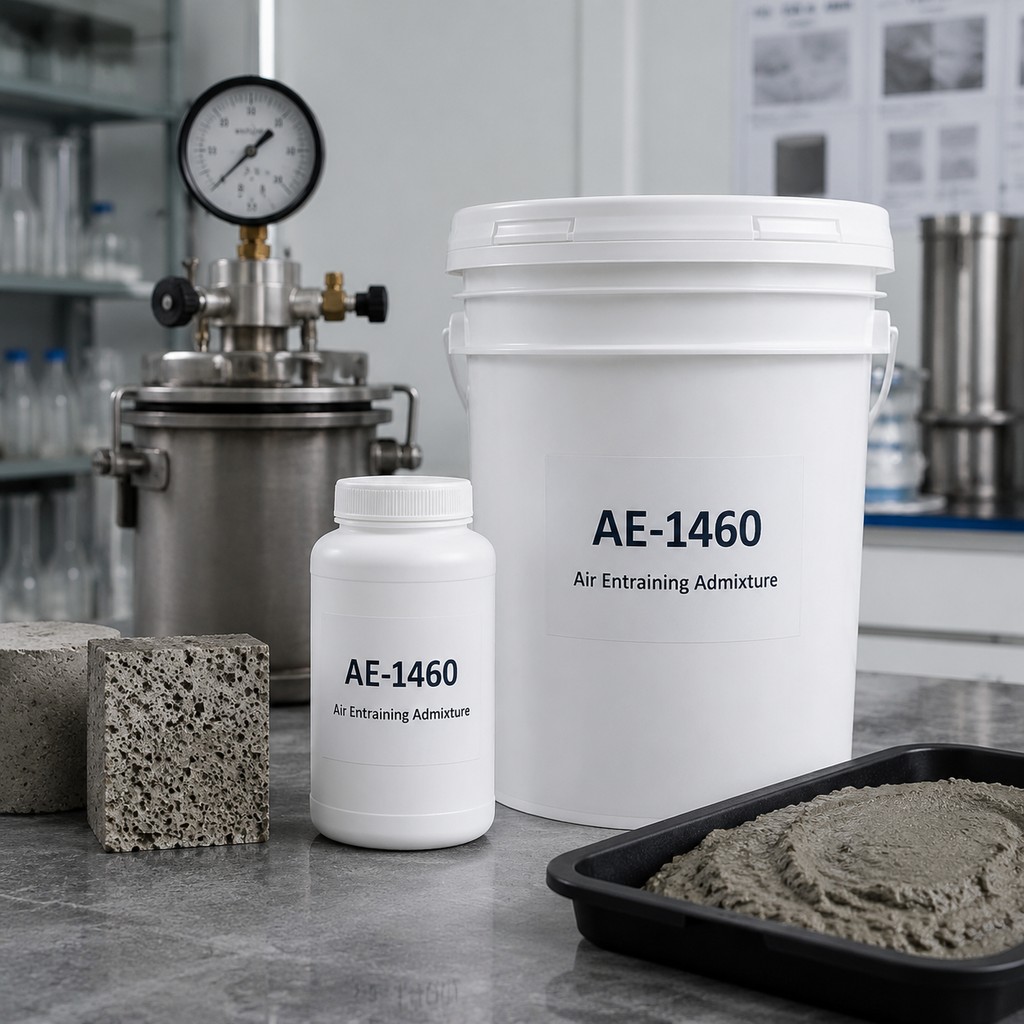
Air entrainment in concrete involves the deliberate incorporation of numerous microscopic air bubbles into a cement-based mixture during the mixing process. These bubbles are usually stabilised by an air-entraining agent — a chemical additive that modifies the mixture’s surface properties and helps maintain a stable air-void system during placement and hardening.
Unlike air that is accidentally trapped due to inadequate consolidation, air that is intentionally entrained is distributed throughout the cement paste in a controlled manner. This distinction is important because the size, spacing, and distribution of air voids can have a significant influence on the durability and performance of hardened concrete.
Air entrainment is particularly valuable in concrete that is exposed to repeated freezing and thawing, moisture, and de-icing chemicals. When water within concrete freezes, it expands and generates internal stresses. Properly distributed microscopic air voids provide spaces into which water can move, thereby reducing the pressure that would otherwise damage the cement paste.
However, air entrainment is not simply a matter of adding more air. Excessive air content can reduce compressive strength, while insufficient or poorly distributed air voids may fail to provide adequate protection. The objective is to strike a balance between durability, workability, strength and long-term performance.
Что такое воздухововлекающий агент?
Добавка агент для удержания воздуха (AEA) is a chemical additive that is added to concrete, mortar, or cement paste to produce and stabilise microscopic air bubbles during the mixing process. It is commonly classified as a surfactant because it reduces the surface tension of the air-water interface, enabling small bubbles to form and remain dispersed in the cementitious mixture.
According to ASTM C260/C260M-24, the influence of air-entraining admixtures on concrete properties, including setting time, compressive strength, flexural strength, and length change, is used to evaluate them. Therefore, an effective AEA must not only introduce air, but also perform consistently without causing unacceptable changes to other concrete properties.
How does an air-entraining agent work?
The mechanism involves several interconnected processes:
- Surface tension reduction: The active ingredients lower the surface tension of the mixing water, making air bubble formation easier during mechanical mixing.
- Bubble stabilization: Surfactant molecules accumulate at the air-water interface, helping stabilize bubbles and reducing their tendency to merge or escape.
- Uniform distribution: Mixing disperses the stabilized bubbles throughout the cement paste, forming a network of microscopic voids.
- Air-void preservation: The stabilized bubbles remain in the concrete during transportation, placement, and consolidation, subject to the effects of mixture design and construction conditions.
- Durability improvement: After hardening, the microscopic voids provide pressure-relief spaces that help protect concrete from freeze-thaw deterioration.
The effectiveness of an air-entraining agent depends on the cement composition, water-to-cementitious-material ratio, aggregate characteristics, other admixtures, temperature, and mixing conditions. Therefore, dosage should be established through laboratory trials rather than determined solely from a supplier’s general recommendation.
How Does Air Entrainment Improve Concrete Performance?
The primary value of air entrainment lies in its ability to improve the behavior of both fresh and hardened concrete. However, the benefits are closely related to the quality of the air-void system rather than total air content alone.
- Improved Freeze-Thaw Resistance
When concrete becomes saturated and exposed to freezing temperatures, the water within its capillary pores can freeze, generating hydraulic and osmotic pressures. Without sufficient relief, these stresses can lead to microcracking, surface scaling and progressive deterioration.
Properly distributed entrained air voids help relieve freezing-induced pressure. Unintentionally entrapped air is not an equivalent substitute for a properly designed air-void system. This mechanism is particularly important for concrete used in outdoor infrastructure such as roads, bridges, car parks and pavements in cold climates.
- Улучшенная обрабатываемость
Air-entraining agents can improve the workability of fresh concrete by introducing small, dispersed bubbles that act somewhat like microscopic ball bearings within the mixture. This can improve cohesion and make concrete easier to place, finish, and consolidate under appropriate mixture conditions.
Improved workability may also reduce the tendency toward segregation and bleeding. Nevertheless, air entrainment should not be considered a substitute for proper aggregate grading, water control, or suitable water-reducing admixtures.
- Reduced Bleeding and Segregation
A stable air-void system can enhance the cohesion of a mixture by influencing the movement of water and solid particles within fresh concrete. This can help to reduce excessive bleeding and segregation, particularly in mixtures where it is important to balance workability and stability.
These benefits depend on the overall mix design. Excessive air content or incompatible admixture combinations can still produce undesirable behaviour in fresh concrete.
- Improved Long-Term Durability
Air-entrained concrete can demonstrate better resistance to freeze-thaw cycles and deicing salt scaling when the air-void system is properly designed. The improvement is not automatic: concrete quality, permeability, curing, exposure conditions, and construction practices continue to play important roles in long-term durability.
What Are the Common Types of Air Entraining Agents?
Air entraining agents can be manufactured from several categories of surface-active materials. Different formulations exhibit different compatibility characteristics, air-generation efficiencies, and responses to cement chemistry.
- Resin-Based Air Entraining Agents
Resin-based formulations, including those derived from wood resins, have a long history of use in concrete technology. When appropriately formulated and dosed, they are valued for their ability to generate and stabilise microscopic air bubbles.
Their performance depends on the composition of the active ingredients and how they interact with cementitious materials. Resin-based products are commonly used in conventional concrete applications that require freeze-thaw protection.
- Synthetic Surfactant-Based Air Entraining Agents
Synthetic air entraining agents may contain carefully formulated surfactants designed to produce stable air bubbles and consistent performance. Their formulation can be adjusted to suit different cement types, mixing procedures, and concrete applications.
They are often considered where consistent air generation and compatibility with modern добавка в бетон systems are important. Actual performance should be established through testing under project-specific conditions.
- Sulfonated Hydrocarbon-Based Air Entraining Agents
Certain sulfonated compounds and related surface-active materials are used to promote air entrainment in concrete. Their ability to reduce surface tension and stabilise bubbles makes them suitable for a variety of cementitious formulations.
However, the performance of these products can be affected by cement chemistry, temperature, dosage, and the presence of other admixtures. Compatibility testing is particularly important when using multiple chemical additives together.
- Fatty Acid and Other Surface-Active Formulations
Fatty acids, their salts, and related surface-active compounds can also be used in air-entraining formulations. Their chemical structure influences bubble generation, stability, and interactions with cement particles.
The most suitable formulation depends on the intended application, concrete mix design, and required air-void characteristics rather than the ingredient category alone.
What Is the Difference Between Entrained Air and Entrapped Air?
Although both entrained and entrapped air occupy space within concrete, they differ considerably in size, distribution, formation mechanism, and contribution to durability. Understanding this distinction is essential for concrete quality control.
| Characteristic | Entrained Air | Entrapped Air |
| Formation | Intentionally introduced using an air-entraining agent | Accidentally incorporated during mixing and placement |
| Размер пузырька | Generally microscopic, often approximately 10–1,000 μm | Typically larger and irregular |
| Distribution | Relatively uniform throughout the cement paste | Often unevenly distributed |
| Shape | Usually small and approximately spherical | Frequently irregular |
| Основная функция | Improve freeze-thaw resistance and workability | Generally provides no intentional durability benefit |
| Control method | Admixture dosage, mixing, and air-content testing | Proper mixing, placement, and consolidation |
Key takeaway: Total air content includes both entrained and entrapped air. Measuring total air alone does not reveal whether concrete contains the fine, properly distributed air voids needed for effective freeze-thaw protection.
Recommended Air Content in Air-Entrained Concrete
The appropriate air content depends on the maximum nominal aggregate size, exposure conditions, concrete composition, and applicable construction specifications. Concrete exposed to severe freezing and thawing typically requires more carefully controlled air entrainment than concrete used in protected interior environments.
The following values are illustrative ranges commonly encountered in conventional concrete mix design. Actual target values must be established using applicable ACI guidance, project specifications, and trial mixtures.
| Nominal Maximum Aggregate Size | Typical Target Air Content for Freeze-Thaw Exposure |
| 9.5 mm (3/8 in.) | Approximately 7–9% |
| 12.5 mm (1/2 in.) | Approximately 6–8% |
| 19 mm (3/4 in.) | Approximately 5–7% |
| 25 mm (1 in.) | Approximately 4.5–6.5% |
| 37.5 mm (1.5 in.) | Approximately 4–5.5% |
These ranges are not universal acceptance criteria. Moderate and severe exposure classifications, aggregate characteristics, and local standards may require different air-content targets.
Why does aggregate size affect air content?
Concrete with smaller maximum aggregate sizes generally requires a higher air content to achieve comparable protection, as it contains a greater proportion of mortar relative to coarse aggregate. Conversely, larger aggregate sizes typically require less total air to achieve the desired air-void distribution in the cement paste.
For this reason, engineers should use recognised mix-design guidance rather than applying a single air-content percentage to all concrete mixtures.
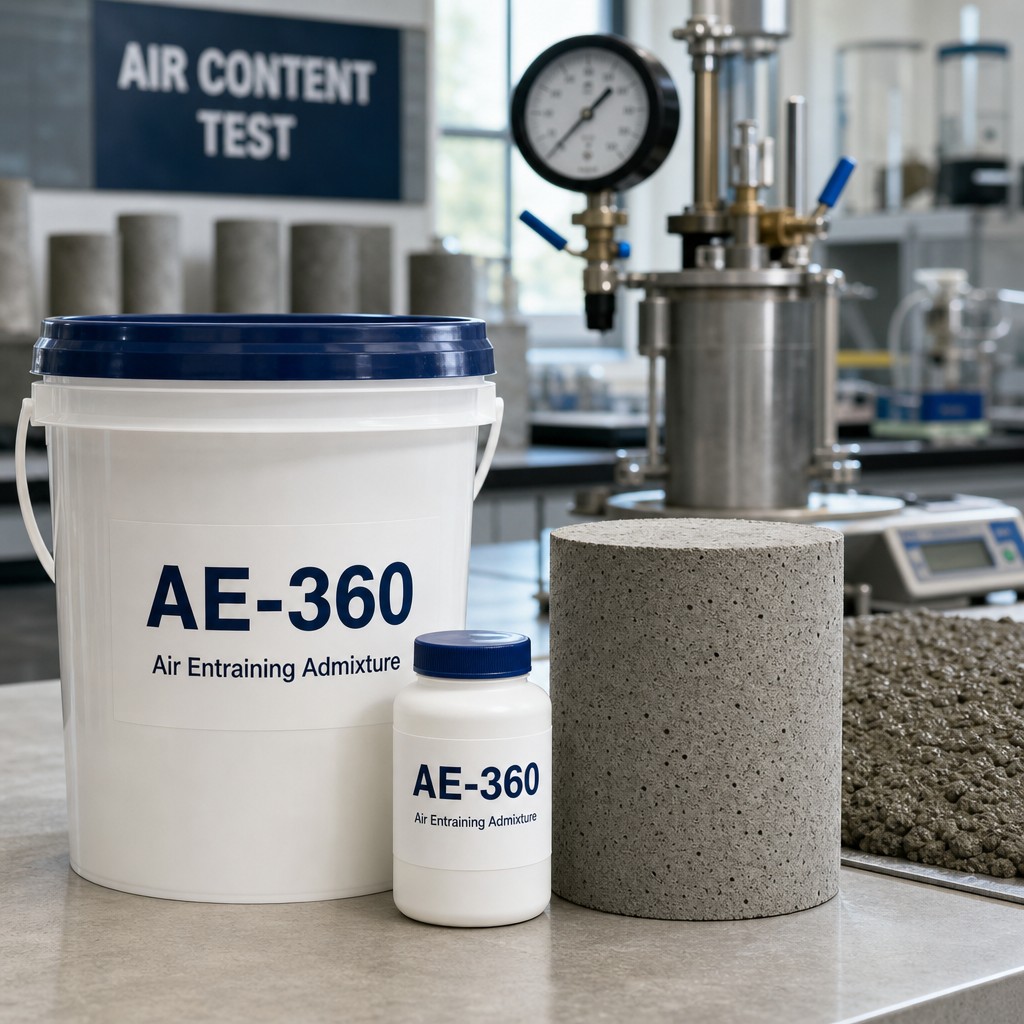
How to Test Air Content in Concrete?
Air-content testing is an essential part of concrete quality control because air-entraining agents can respond differently under varying material and environmental conditions. The two most common methods for determining air content in fresh concrete are the pressure method and the volumetric method.
- Pressure Method — ASTM C231
The pressure method uses a calibrated air meter to determine the air content of fresh concrete. It is widely used on construction sites because the test can be performed relatively quickly and provides practical results for routine quality control.
This method is appropriate for many normal-weight concrete mixtures, although aggregate characteristics and instrument calibration must be considered.
- Volumetric Method — ASTM C173
The volumetric method determines air content by using water and a specified procedure to measure the volume of air within the concrete sample. It is particularly useful when the pressure method may be affected by porous or lightweight aggregates.
Both methods measure the overall air content of fresh concrete. Neither independently establishes whether the microscopic air-void system in hardened concrete is sufficiently fine or properly spaced.
- Hardened Concrete Air-Void Analysis — ASTM C457
ASTM C457 provides procedures for evaluating the air-void system in hardened concrete through microscopic analysis. Parameters such as specific surface, spacing factor, and air-void distribution help engineers assess the potential effectiveness of entrained air in protecting concrete against freeze-thaw damage.
This analysis is particularly valuable when durability problems occur or when the performance of an air-entrained mixture must be investigated beyond routine fresh-concrete air testing.
Factors That Influence Air Entraining Agent Performance
The actual air content and air-void characteristics achieved in concrete are influenced by multiple factors. A dosage that performs well in one mixture may not produce the same result in another.
- Cement and Supplementary Cementitious Materials
Cement composition, fineness, and alkali content can influence the response of air-entraining agents. Fly ash, slag, silica fume, and other supplementary cementitious materials may also change air demand and bubble stability.
- Dosage and Compatibility
Air-entraining agents must be compatible with other admixtures, including water reducers, superplasticizers, retarders, and accelerators. Interactions may increase or decrease air content, so the complete admixture combination should be tested.
- Mixing Time and Equipment
Mixing speed, duration, batch size, and sequence of material addition can influence the formation and stability of air bubbles. Excessive mixing or unsuitable procedures may alter the air-void system.
- Temperature and Transportation
Concrete temperature affects the behavior of air-entraining agents and the stability of the fresh mixture. Transportation time, pumping, vibration, and placement can also change the air content before the concrete hardens.
- Aggregate Characteristics
Aggregate grading, maximum size, surface texture, and moisture conditions influence the amount and distribution of air in the concrete. Consistent aggregate quality supports more predictable air-entrainment performance.
How to Select the Right Air-Entraining Agent for Concrete?
Selecting an air-entraining agent requires more than comparing chemical products or dosage rates. Engineers should evaluate the complete concrete mixture and the expected exposure conditions.
A practical selection process includes the following steps:
- Define exposure conditions: Identify whether the concrete will experience freezing and thawing, deicing chemicals, moisture saturation, or other durability-related risks.
- Determine target air content: Establish the required air content based on aggregate size, exposure classification, and project specifications.
- Evaluate admixture compatibility: Test the proposed air-entraining agent alongside other admixtures and cementitious materials in the mixture.
- Conduct laboratory trials: Measure fresh-concrete air content, workability, setting behavior, and strength development under representative conditions.
- Verify air-void characteristics: For critical durability applications, consider hardened concrete air-void analysis rather than relying exclusively on total air content.
- Establish quality-control procedures: Define dosage control, sampling frequency, air-content tolerances, and monitoring procedures for field production.
A reliable supplier should provide technical documentation, recommended application ranges, compatibility guidance, and support for performance verification. The final selection should be based on demonstrated performance in the actual concrete mixture.
Frequently Asked Questions About Air Entraining Agents
Q1: What is the main purpose of an air entraining agent in concrete?
An air entraining agent introduces and stabilizes microscopic air bubbles to improve concrete workability and freeze-thaw resistance. It helps create a protective air-void system within the hardened cement paste.
Q2: Does air entrainment increase or decrease concrete strength?
Air entrainment generally reduces compressive strength when other mixture parameters remain unchanged because air voids occupy part of the concrete volume. However, improved workability and the possibility of reducing mixing water can influence the final strength, so the actual effect should be determined through testing.
Q3: How much air-entraining agent should be added to concrete?
There is no universal dosage because the required amount depends on the product formulation, cement chemistry, aggregate properties, temperature, and desired air content. The correct dosage must be established through laboratory trials and verified during field production.
Q4: Is air-entrained concrete suitable for all construction projects?
No. Air entrainment is particularly beneficial for concrete exposed to freezing and thawing, while other applications may require different air-content targets. Engineers must consider structural strength, durability requirements, and project specifications before using an air-entraining agent.
Q5: Can air entraining agents be used with superplasticizers?
Yes, air-entraining agents are commonly used with water reducers and superplasticizers in modern concrete mixtures. However, interactions between admixtures can significantly change air content, so compatibility testing and dosage adjustments are necessary.
Q6: What is the difference between an air-entraining agent and an air-entraining admixture?
The terms are generally used interchangeably in concrete technology to describe a chemical admixture that produces microscopic air bubbles during mixing. Both refer to materials intended to develop a stable entrained-air system in cementitious mixtures.
Заключение
Air entrainment is a key concrete technology that enhances workability and promotes long-term durability, especially in areas subject to freezing and thawing. The air-entraining agent plays a central role in producing a stable system of microscopic bubbles; however, its effectiveness depends on proper dosage, material compatibility, mixture design, and construction practices.
The most important consideration for concrete producers, engineers and admixture suppliers is not simply achieving a specified total air content. Rather, it is about developing a well-distributed air-void system that meets durability requirements without compromising strength or other critical performance characteristics. When combined with standardised testing and consistent quality control, the appropriate admixture selection can ensure the reliable performance of air-entrained concrete throughout its service life.
Technical Reference
FHWA: Air Entrainment and Concrete Durability (FHWA-HIF-17-009) explains the role of the air-void system in freeze-thaw durability. Use the standards and editions specified for the project when setting acceptance criteria.