
A water-repellent additive is a chemical ingredient that is added to or applied to a material’s surface to reduce its absorption of water, its wetting, and its capillary penetration. It is widely used in concrete and masonry, textiles, coatings, paper, and other porous materials. The Concrete Society’s guidance on water-resistant admixtures, as well as the peer-reviewed publication Water Repellent Coatings in Textiles, Papers and Bioplastic Polymers, provide more information on this topic. A Comprehensive Review explains how hydrophobic ingredients alter water interaction, emphasising that performance depends on the substrate and formulation.
The purpose of a water-repellent additive is not necessarily to make a product completely waterproof. Depending on the application, it may help to reduce rainwater absorption, prevent fabrics from becoming wet, limit moisture-related staining, improve durability or protect materials from the effects of repeated wetting and drying. Selecting the appropriate additive necessitates an understanding of its intended use, its mechanism of action, and whether the finished product must also resist water vapour, hydrostatic pressure, abrasion, washing, or chemical exposure.
What Is a Water-Repellent Additive?
A water-repellent additive is a substance that is either incorporated into a formulation or applied during manufacturing to reduce a material’s ability to be wetted by water. It can be mixed into concrete, blended into coatings, applied to fabrics during the finishing process, or introduced into paper and other porous products. Some additives work by reducing the surface energy of a material, causing water to form droplets rather than spreading across the surface. Others line the internal pores of a material with hydrophobic compounds, thereby reducing the capillary forces that draw water into it.
Water repellency differs from waterproofing. A water-repellent surface can withstand rain, splashes or brief contact while still allowing moisture vapour to pass through. By contrast, a waterproof membrane is designed to prevent liquid water from passing through under specified conditions. This distinction is important in applications such as exterior walls, breathable outdoor clothing and concrete structures exposed to groundwater, as a treatment that reduces surface absorption may not withstand continuous water pressure or seal cracks.
Therefore, the term ‘water-repellent additive’ describes a function rather than a single chemical family. The right product depends on the base material, production method, exposure conditions, and required service life. For example, a textile finish must withstand flexing and laundering, while a concrete admixture must remain compatible with cement hydration and the concrete mix. A formulation designed for one application should not be assumed to be suitable for another.
How Does a Water-Repellent Additive Work?
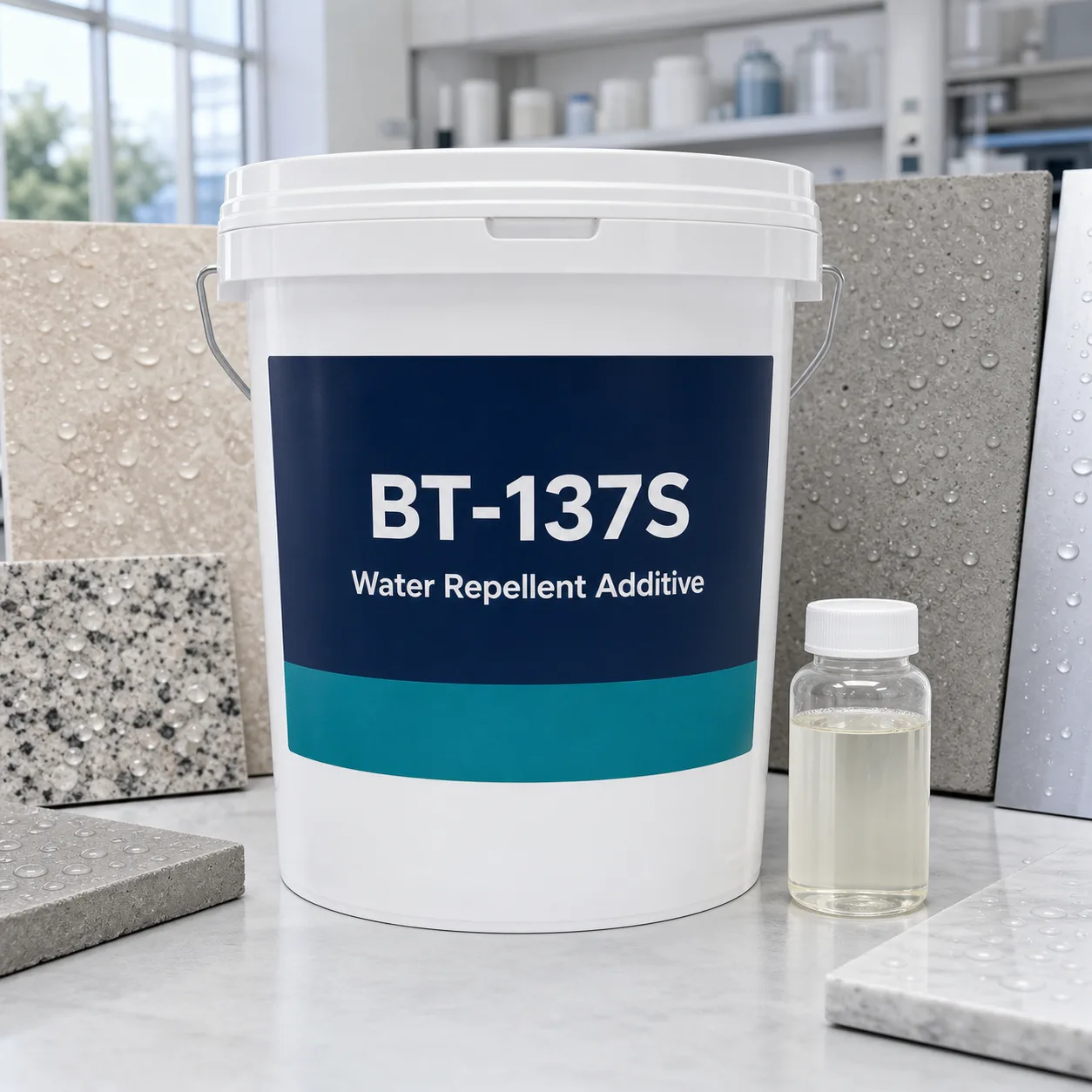
Most water-repellent additives work by altering the way water interacts with a solid surface. On a treated surface, water tends to spread less easily and may form droplets that have a higher contact angle. In porous materials, a hydrophobic treatment can also alter the surface chemistry within the pores, making it more difficult for water to enter via capillary action. The exact mechanism depends on the active ingredients, surface structure, application method, and substrate.
Three broad approaches are common:
- Surface-energy modification: Hydrophobic compounds reduce the tendency of water to spread over a treated surface. This is common in textile finishes and protective coatings.
- Pore-wall treatment: Ingredients such as silanes and siloxanes can form hydrophobic surfaces within suitable mineral substrates, reducing capillary water absorption without necessarily filling the pores.
- Pore blocking or barrier formation: Certain formulations partially fill pores or create a film that restricts liquid-water movement. These products may provide a different level of protection from penetrating water repellents.
The distinction between these mechanisms is important in specification and quality control. The Concrete Society explains that water-resisting concrete admixtures may reduce the continuity of capillary pores, block pores, or line them with hydrophobic materials; it also warns that such admixtures do not significantly reduce water penetration through cracks or poorly compacted concrete.
A useful way to assess performance is to consider the full exposure profile rather than a single demonstration in which water beads on the surface. Water repellency under light rain does not automatically establish resistance to immersion, pressure, detergent, abrasion, or repeated washing. For manufacturers, performance testing should reflect the finished product’s actual use, including its expected maintenance cycle and environmental conditions.
What Are the Main Types of Water-Repellent Additives?
Water-repellent additives are available in several chemical families, each with its own strengths and limitations. The most relevant categories are silane and siloxane treatments for mineral building materials; silicone-based finishes for selected textiles and surfaces; wax-based formulations; and specialised polymer or fluorochemical finishes. While some applications overlap between the categories, their performance cannot be compared without considering the substrate and the way the treatment is applied.
- Silane and siloxane additives
Silane and siloxane products are widely used to reduce the water absorption of concrete, masonry, brick and stone. Depending on the formulation and substrate, silanes can penetrate relatively deeply into suitable mineral surfaces, whereas siloxanes are useful for a variety of porous building materials. These treatments generally aim to create hydrophobic pore surfaces rather than forming a thick film on the surface.
Advantages may include reduced capillary absorption and limited visible change to the substrate. However, their effectiveness depends on porosity, moisture content, surface preparation, concentration, and curing conditions. A treatment designed for cement-based concrete may not be equally effective on all types of brick, natural stone or previously coated surfaces. The National Association of Home Builders’ technical resource on silane and siloxane repellents discusses these differences and emphasises the importance of matching the treatment to the material.
- Silicone-based additives
Silicone-based additives are used in selected textile finishes and coatings where it is necessary to adjust water repellency and surface properties. In textiles, silicone polymers such as polydimethylsiloxane can reduce surface wettability; the formulation may also affect the fabric’s feel, flexibility, and durability. A review of silicone, silane, wax, polymer, and other approaches to water-repellent textile and paper treatments has been published in Polymers.
The benefits depend on the complete formulation rather than the silicone ingredient alone. The binder, application concentration, curing process, and interaction with the substrate all influence how evenly the treatment is deposited and how well it withstands wear and tear. Manufacturers should test finished fabrics or products for repellency and for the retention of other necessary properties, such as breathability, softness, adhesion, or flexibility.
- Wax-based additives
Some construction materials, paper products, and surface treatments use wax-based water repellents. Waxes can form a hydrophobic layer or alter the surface of pores, thereby reducing the tendency of water to spread or be absorbed. They can be useful when a product requires water resistance without the need for a complex coating system. However, their performance can vary depending on the wax chemistry, dispersion, substrate, and service conditions.
Potential limitations include changes to the surface’s appearance, reduced adhesion of subsequent coatings, and sensitivity to heat or abrasion in some formulations. In cement-based materials, the dosage and compatibility of a wax-containing admixture must be considered alongside the other components of the concrete mix. A product suitable for a low-pressure moisture control application should not be automatically selected for a structure that must resist sustained hydrostatic pressure.
- Polymer and fluorochemical finishes
Polymer-based treatments can create continuous or semi-continuous protective layers. Fluorochemical finishes have historically been used in textiles requiring strong water repellency. The performance of different chemistries can vary substantially, and a water-repellent finish may also affect oil repellency, breathability, surface feel and resistance to repeated laundering.
Environmental and regulatory considerations are becoming increasingly important when choosing speciality finishes. Some fluorinated substances fall within the broad category of per- and polyfluoroalkyl substances (PFAS), which are of concern due to their persistence and potential environmental and health impacts. Research into fluorine-free alternatives, including silicone- and silane-based systems, continues. However, alternatives should be assessed using comparable durability and performance tests rather than being assumed to be equivalent based on their chemistry alone.
Where Are Water-Repellent Additives Used?
The following table summarizes common application areas and the performance requirements that should be checked before choosing an additive.
| Industry or material | Typical purpose | Key selection considerations |
| Concrete and masonry | Reduce rainwater absorption and capillary moisture ingress | Substrate porosity, water pressure, cracking, breathability, and compatibility with the mix |
| Textiles and apparel | Help fabric resist rain or accidental splashes | Laundering durability, abrasion resistance, breathability, fabric hand, and chemical restrictions |
| Paper and packaging | Reduce wetting or moisture-related loss of performance | Repulpability or recyclability, food-contact requirements, coating adhesion, and end use |
| Paints and protective coatings | Reduce surface wetting and water uptake | Adhesion, compatibility, gloss, weathering, and recoating requirements |
| Wood and wood-based products | Reduce liquid-water absorption and weathering-related moisture exposure | Penetration, dimensional movement, UV exposure, coating maintenance, and intended service |
| Construction blocks, tiles, and precast products | Reduce surface absorption and improve resistance to repeated wetting | Mix compatibility, curing, strength, efflorescence, and exposure conditions |
- Construction and concrete
In construction, water-repellent additives can be incorporated into concrete mixes or applied as surface treatments to minimise moisture absorption. This limits the movement of water and dissolved salts into the material, thereby supporting its durability when exposed to the right conditions. This is especially beneficial for surfaces that experience repeated wetting and drying, such as exposed walls, paving and certain precast products.
However, water-repellent treatment is not a substitute for structural waterproofing. Where there is continuous or high water pressure, a permeability-reducing system, membrane, drainage design or other engineered waterproofing measure may be necessary. The Concrete Society notes that water-repellent admixtures cannot compensate for cracks or poorly compacted concrete. This makes sound mix design, placement, curing and crack control essential.
- Textiles and apparel
In textiles, a water-repellent additive causes water to bead on the fabric’s surface rather than spreading into its fibres. This additive is used in outdoor clothing, bags, upholstery, tents, workwear and selected protective fabrics. Depending on the product, the finish can be applied by padding, dipping or spraying, or by another controlled finishing process. This is then followed by drying or curing, if necessary.
The challenge lies in balancing water repellency with other fabric requirements. Heavy or poorly selected treatments can affect softness, flexibility, breathability, and appearance, and repeated washing and abrasion can reduce performance. The review ‘Water Repellent Coatings in Textiles, Papers, and Bioplastic Polymers’ describes application methods and several water-repellent chemistries, emphasising that deposition and surface structure influence the final result.
- Paper, packaging, and coatings
Paper and packaging manufacturers use water-repellent additives to make products resistant to splashes, damp handling or short periods of moisture exposure. Depending on the design, the additive may be introduced during the papermaking process or applied as a surface coating. The correct additive must be chosen based on the end use of the packaging, including whether it must be recyclable, repulpable, suitable for food contact, or compatible with printing and adhesive bonding.
Protective coatings use water-repellent additives to limit wetting and moisture uptake, particularly on exposed surfaces. However, repellency is only one aspect of coating performance; other important factors include adhesion, UV stability, abrasion resistance, chemical resistance and vapour transmission. A successful formulation must deliver the intended water behaviour without compromising the coating’s other functional requirements.
How to Choose the Right Water-Repellent Additive?
The selection of a water-repellent additive begins with the definition of the requirements of the finished product. The needs of a textile exposed to light rain differ from those of concrete in contact with groundwater, for example, and a paper package exposed to occasional splashes differs from packaging designed for chilled or wet products. Therefore, the best additive is one that meets the required performance criteria while remaining compatible with the substrate, manufacturing process, safety requirements, and expected service life.
Use the following steps when evaluating candidate products:
- Identify the substrate. Establish whether the material is concrete, masonry, fabric, paper, wood, polymer, or a coated surface. Porosity, surface chemistry, existing finishes, and moisture content can influence how well an additive penetrates or bonds.
- Define the water exposure. Distinguish occasional splashes, wind-driven rain, repeated washing, immersion, and sustained hydrostatic pressure. These conditions are not interchangeable, and a product that performs well in one may be unsuitable for another.
- Set the performance target. Decide whether the priority is lower water absorption, surface beading, reduced capillary uptake, retained fabric breathability, or resistance to moisture-related deterioration. Specify the required performance using a test method relevant to the finished product.
- Check compatibility and processing conditions. Review the recommended dosage, application technique, curing or drying requirements, and interaction with other ingredients. For concrete, assess the effect on fresh and hardened properties; for textiles, assess fabric feel, color, and finishing performance.
- Evaluate durability and compliance. Consider weathering, washing, abrasion, UV exposure, chemical restrictions, and any applicable food-contact or environmental requirements. Ask the supplier for the technical data sheet, safety data sheet, and supporting test results.
- Run a representative trial. Test the treated material under conditions that resemble its intended use. A small laboratory test can screen candidates, but production-scale trials may be needed to confirm uniform application, process stability, and long-term performance.
The following table shows how to connect common requirements with appropriate evidence when comparing products.
| Requirement | Useful evaluation method or evidence | What to verify |
| Reduced water absorption in concrete | Capillary absorption or water-penetration testing appropriate to the application | Whether the treatment meets the specified exposure conditions |
| Surface water repellency on textiles | Spray testing, water-contact-angle measurement, or another agreed textile method | Initial performance and retention after washing or abrasion |
| Resistance to water in coatings | Water-immersion, water-spot, weathering, or coating-specific tests | Whether the coating remains intact and adherent |
| Durability outdoors | Weathering, UV exposure, wet-dry cycling, and relevant field trials | Whether repellency and other critical properties persist over time |
| Manufacturing compatibility | Trial batches and process monitoring | Mixing stability, application uniformity, curing, and final product quality |
| Environmental and regulatory suitability | Supplier documentation and applicable regulatory assessment | Chemical restrictions, emissions, disposal, and end-use approvals |
Do not compare products based only on the active ingredient or the percentage stated on the label. Two formulations containing similar chemistry may behave differently because of molecular structure, carrier system, solids content, dispersion quality, or interaction with the substrate. A supplier that can provide clear application instructions and relevant test data is generally a more useful technical partner than one that offers only broad claims such as “complete waterproofing” or “permanent water repellency.”
How Are Water-Repellent Additives Applied?
The application method depends on whether the additive is incorporated during the manufacturing process or applied to an existing surface. Integral additives, such as a concrete admixture added during batching, are blended into a material, while surface treatments may be sprayed, brushed, rolled, padded, dipped, or applied using industrial coating equipment. Control over dosage, coverage, substrate condition, and curing or drying is required for each method so the active ingredients can perform as intended.
For concrete and masonry treatments, surface preparation is particularly important. Dust, oil, loose particles, previous coatings, and unsuitable moisture conditions can interfere with penetration or adhesion. The product instructions should specify the acceptable substrate condition, application rate, number of coats, and curing period. When using integral concrete admixtures, it is essential to follow the manufacturer’s dosage and mixing sequence, ensuring that the final mix meets the required workability, strength, durability, and construction specifications.
For textile finishing, consistent application is essential to avoid uneven coverage and patchy repellency. The result may be influenced by concentration, bath conditions, fabric speed, drying temperature, and curing time. Manufacturers should also ensure that the treated fabric retains the necessary breathability, softness, colour, and mechanical properties. In any industry, the most reliable process is to combine supplier guidance, controlled production conditions and testing of the finished product, rather than relying on the additive’s nominal specification alone.
Limitations and Common Mistakes
A common misconception is that water repellency means complete waterproofing. While water-repellent additives generally reduce wetting or absorption, they do not necessarily resist prolonged immersion, sustained water pressure, or leakage through cracks and joints. This distinction is particularly important in construction, where water can still enter through defective details even if the surrounding surface has been successfully treated.
Another common mistake is choosing an additive without considering the material’s other performance requirements. For example, a treatment that improves water beading may reduce coating adhesion, alter fabric texture, complicate recycling, or interfere with subsequent processing. Using more than the recommended dosage is not a reliable way to improve performance: it can increase costs and may adversely affect the finished material or manufacturing process. The correct dosage is the one validated for the specific formulation and production method.
Finally, initial performance does not guarantee long-term durability. Exposure to UV light, detergents, abrasion, temperature changes, and repeated wetting can degrade or remove some treatments. Therefore, a meaningful evaluation should consider both initial repellency and retention after relevant ageing or service simulations. Where the product protects a critical structure or safety-related component, the specification should be supported by test results and engineering review.
Frequently Asked Questions About Water-Repellent Additives
- What is a water-repellent additive used for?
A water-repellent additive reduces water wetting or absorption in materials such as concrete, textiles, paper, coatings, and wood products. It helps improve moisture resistance, but it does not automatically make a product fully waterproof.
- What chemicals are used as water-repellent additives?
Common options include silanes, siloxanes, silicone polymers, waxes, and selected polymeric or fluorochemical treatments. The appropriate chemistry depends on the substrate, required durability, application process, and regulatory requirements.
- What is the difference between a water-repellent additive and a waterproofing additive?
A water-repellent additive generally reduces surface wetting or capillary absorption, whereas a waterproofing system may be designed to resist liquid water under more demanding conditions. The terms can overlap in commercial descriptions, so check the product’s specified performance and test results.
- Can a water-repellent additive be mixed into concrete?
Yes, certain water-repellent admixtures are designed to be added during concrete batching to reduce capillary water absorption. The dosage and compatibility must be verified, and the admixture cannot compensate for cracks, poor compaction, or unsuitable concrete design.
- Are water-repellent additives suitable for textiles?
Yes, water-repellent finishes are used on clothing, outdoor fabrics, bags, upholstery, and other textile products. The finish should be evaluated for breathability, feel, durability after washing, and any relevant chemical or environmental restrictions.
- How long does a water-repellent additive last?
Service life varies with the chemistry, substrate, application quality, weather exposure, abrasion, washing, and maintenance. Use durability tests and the manufacturer’s guidance to establish realistic expectations rather than assuming the treatment is permanent.
Conclusion
Water-repellent additives are used to reduce water absorption, surface wetting, and capillary moisture movement in a wide range of materials. Silane and siloxane treatments are commonly used in concrete and masonry, while silicone and polymer finishes are used in selected textile and coating applications. Wax-based formulations, meanwhile, serve particular construction and packaging needs. Each additive offers a different balance of repellency, durability, breathability, processing requirements, and environmental impact.
The key for manufacturers and material specifiers is to match the additive to the substrate and the actual exposure conditions. The intended function, compatibility, application method, durability, and relevant test results should be evaluated before selecting a product. A well-chosen water-repellent additive can improve moisture resistance and extend service life. However, reliable results depend on sound material design, correct application, and performance verification.